A plan on the wallpaper
I pay serious money for AI agents, and they work fast. What I was missing was one plan above everything that tells me what I am on today and what can wait.
Every month I pay for several AI subscriptions, and it is not a small amount, because agents do a large part of my work. For a long time I thought that was the whole price. Then I noticed that with ten or so projects in flight I could no longer answer a simple question: what am I on today, and what can wait until tomorrow.
The work had not stopped. An agent answers in a second and there is always a next step, so I worked six hours without a breath, with five projects in my head. The pauses that work used to have by itself were gone: waiting for a build, for a colleague, for tomorrow. With them went the time in which you sleep on a decision.
No more cards
Work used to be run on a board of cards, in Trello or something like it. One task, one card, one person who moves it when it is done. That made sense while a task took a day or two.
Today an agent finishes such a task while I am still writing the card. I no longer run the small tasks myself, so a board full of them tells me nothing. What is left to me is larger than a card: which phase each project is in, what repeats, and which decision I made.
What repeats
Many processes are not one-off. The newsletter goes out every Thursday, the invoice on the 30th, and reports and analyses have to be read to the end before anything moves on. These are jobs an agent cannot do for me, because they are where the deciding happens.
They are also the first to drop out when everything moves fast. Nobody asks for them, and there is always something new that can be started instead. AI speeds up the work, but nobody guarantees it is not speeding up the piling up of mistakes as well.
One plan
I needed one master plan above all the tools: a few large blocks per project, the things that repeat, and nothing smaller than that. I also needed it to stay accurate without me copying things into it. When an agent finishes a phase, or when I decide something, the plan has to change at that moment, not when I remember.
No tool I tried did that. Either it wanted everything entered by hand, so the plan was behind reality by the second day, or it was one more tab in the browser. And a plan you have to open is a plan you stop opening after a while.
Daydeck
So I built Daydeck. It is a Mac app that draws the plan as the desktop wallpaper: one lane per project, a few big blocks per lane, one line for today. You do not open it, because it is always there, behind the icons.
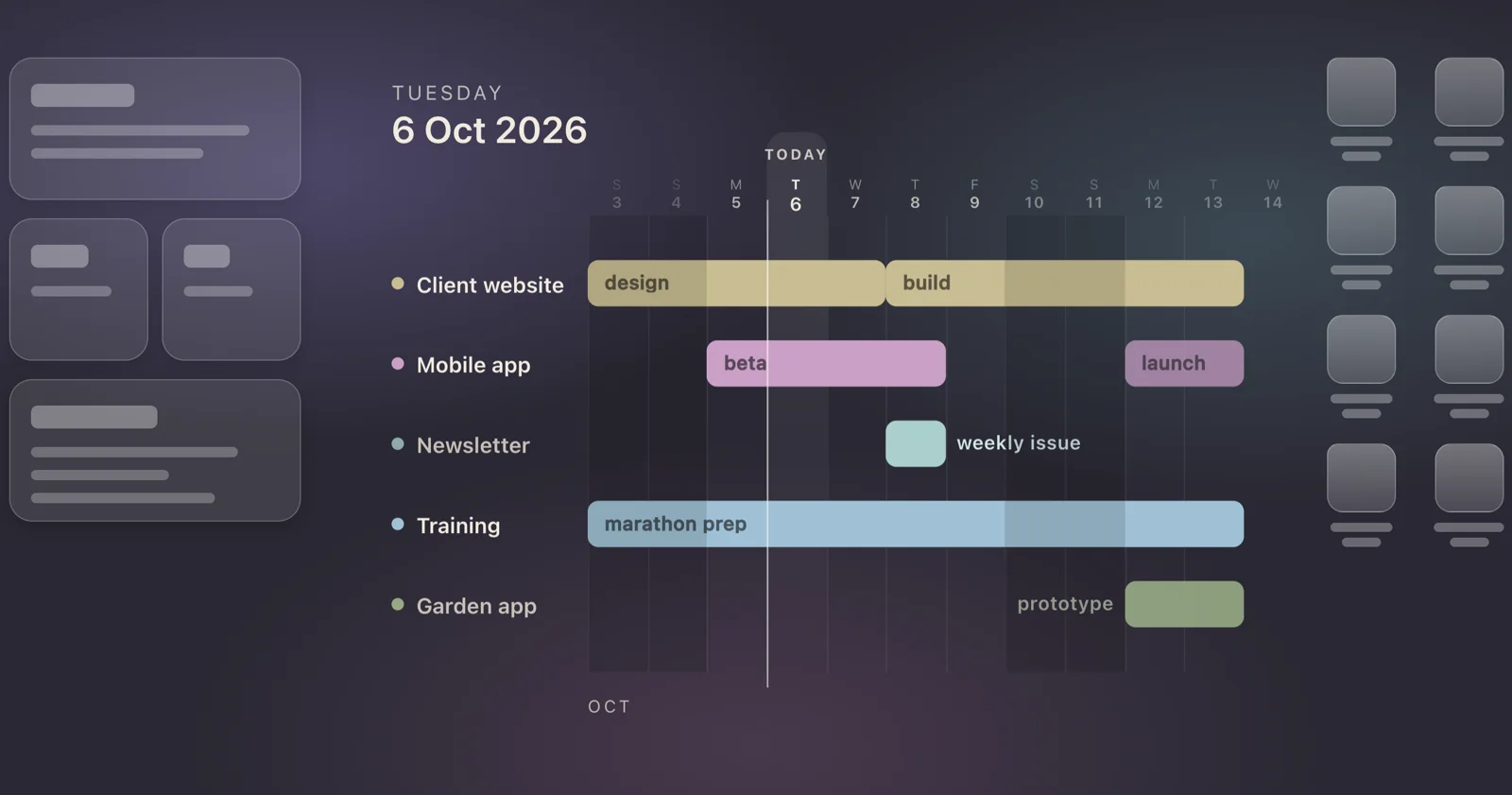
Daydeck is not a task manager and not a calendar. It has no checkboxes, no sub-tasks and no hours. A block has a name of a few words, for example "Roko • beta", and lasts two to ten days. Anything smaller stays in the tools where the work is done.
Claude keeps the plan up to date. A connector lets it read the plan and add and move blocks, and it works in Claude Desktop, Claude Code and Cursor, which is where the agents work anyway. On Monday I say what changed, it proposes the two weeks, says plainly what does not fit, and writes it down only once I confirm. On Friday I say what moved.
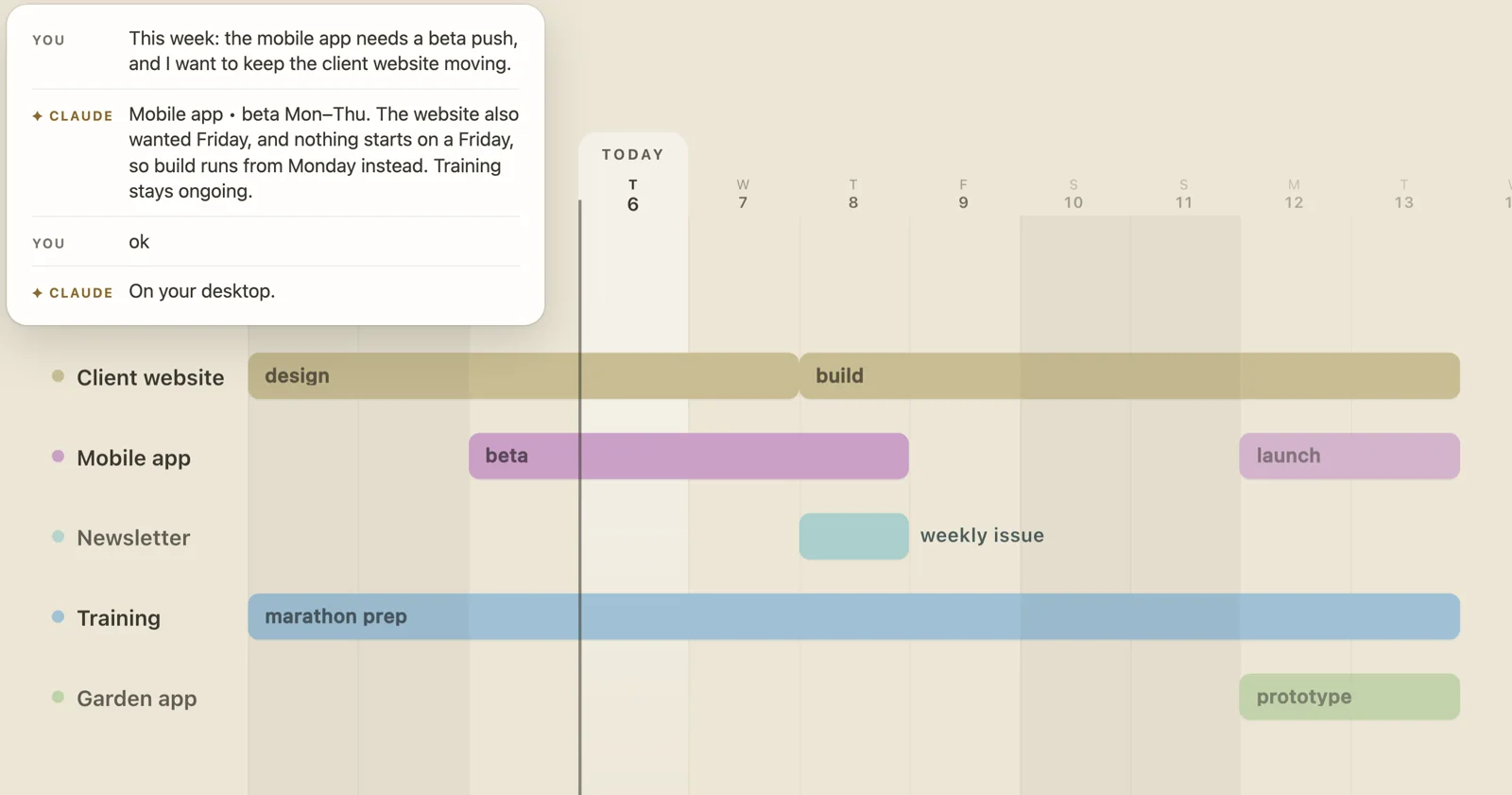
A few rules come with it, and they put the pauses back. On any one day at most two projects have a block. The weekend stays empty. Nothing starts on a Friday, because Friday is for finishing and thinking. When something does not fit, Claude does not squeeze the plan. It says what has to move.
The app itself never goes online. Everything is in one file on my Mac, with no account and no cloud.
What I got
Daydeck does not help me do more. It helps me do the right amount, in the right order. I find it hard to turn that into a percentage, but I can say what changed: I keep to the plan, I sometimes sleep on a decision, the things that repeat actually happen, and I read the analyses when their turn comes. It has saved me nerves, time and money. Very quickly it became a tool I would not want to work without.
I shaped it while solving my own problem, and then decided other people could use it too. It has been on the Mac App Store since June. It is free for two projects, forever. Unlimited projects cost €14.99 once, with no subscription.
- Daydeck: daydeck.krnic.be
- How it works with Claude: daydeck.krnic.be/claude
- Download: Mac App Store
The same amount still goes to AI subscriptions every month. The difference is that I now know what I am on today and what is waiting. If your agents also work faster than you can follow, who decides what should not start this week?